Good to know

Corporate Maturity Levels – Queer Diversity

How fit is your company when it comes to queer issues?

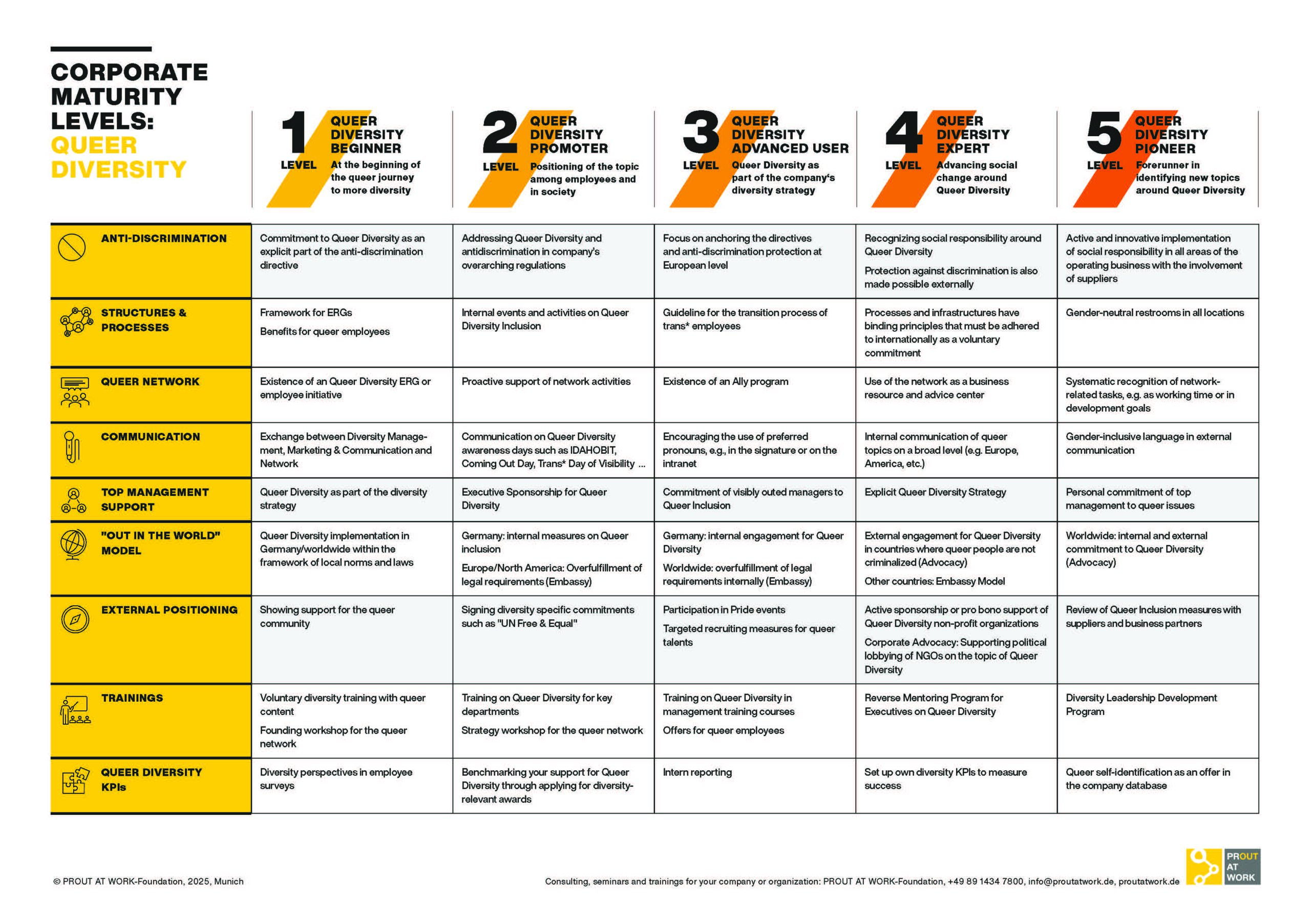
Absolute beginner or pioneer – where does your company or organization stand on queer issues? With the “Corporate Maturity Levels – Queer Diversity” we offer companies a free tool that allows them to systematically assess and further develop their commitment to queer inclusion.

Identify opportunities. Develop strategies. Make an impact.

This self-assessment tool helps you to understand your organization’s current state, identify opportunities for growth,
and define concrete next steps – toward a more inclusive work environment.

PAW_Maturity_Levels_2026_EN

Levels and content

Get an overview of key topics and potential actions that can be implemented at each level, from 1 (Beginner) to 5 (Pioneer), and discover tips to help you promote queer inclusion in the workplace.

Anti-Discrimination

Level 1:

Commitment to queer diversity as an explicit part of the anti-discrimination policy

Compliance with the minimum legal standards of the German General Equal Treatment Act (AGG)

Level 2:

Addressing queer equality and anti-discrimination in overarching company policies

Protection against discrimination and bullying based on sexual orientation and gender identity is explicitly enshrined in the code of conduct or in comparable overarching documents. Implementation of training, development, and structure

Level 3:

Focus on anchoring the policies and anti-discrimination protection at the European level

Level 4:

Recognizing the social responsibility surrounding queer diversity. Protection against discrimination is also enabled externally (customers)

Level 5:

Active and innovative implementation of social responsibility in all areas of operations, including suppliers.

Structures & Processes

Level 1:

Framework for ERGs/BRGs; What is important/helpful for successful networks; Benefits

Level 2:

Organizing internal events/activities on queer inclusion

The company initiates events and internal activities to raise awareness of its commitment to queer inclusion and to attract more supporters.

Level 3:

Guidelines for the transition process of trans* employees

The transition process is guided by guidelines that describe the essential steps and associated responsibilities within the company.

Level 4:

Processes and infrastructures have binding principles that must be adhered to internationally as a form of self-commitment.

Level 5:

Gender-neutral restrooms at all locations

In addition to restrooms for men, women, and people with disabilities, restrooms for all genders are also available.

Taking Risks

Queer Network

Level 1:

Existence of a queer network or employee initiative

Employees have formed a group that focuses on queer inclusion in the workplace.

Level 2:

Proactive support for network activities

The company facilitates the network’s work, for example, by providing communication tools, meeting spaces, or financial resources.

Internal visibility (communication and official recognition)

Contact persons

Internal events

Level 3:

Existence of an ally program

Queer allies stand in solidarity with queer people and advocate for them—especially in situations where they themselves cannot. People who do not identify as queer, as well as closeted members of the queer community, can become ambassadors and supporters for queer participation in the workplace. The program promotes a safe, inclusive work environment by, among other things, creating visible symbols for the queer community.

Structures

International Cooperation

External Visibility (Events, Communication)

Level 4:

Using the network as a business resource and advisory service

The queer network is recognized as a de facto resource for the company, maintains close contact with the HR, marketing, and business departments, and advises them on topics such as employer branding for the queer target group or developing new customer groups.

External Networking

Logo Use

International Initiatives

Diversity of the Core Team

Level 5:

Systematic Recognition of Network Work, e.g., as working time or in development goals

The added value of the commitment to queer inclusion in the workplace is recognized and treated accordingly, e.g., in the form of time off in lieu or as an important component of personal goals in annual/feedback reviews (possibly linked to bonuses or promotions).


Cross-Company Events

External Representation of the company

High Awareness within the company

Size of the Network

Communication

Level 1:

Inventory, needs assessment Exchange between Diversity Management/Marketing & Communications and the network Internal

Level 2:

Communication about queer holidays such as IDAHOBIT, Coming Out Day, Trans* Day of Visibility, etc., and about the visibility/engagement of the network

The company informs employees about the respective holidays (e.g., in the newsletter or calendar) and also promotes this engagement externally, for example, via social media or participation in company-wide campaigns.


Internal/External

Level 3:

Encouragement of the use of preferred pronouns, e.g., in email signatures or on the intranet

Employees can use their preferred pronouns in their email signatures, on the intranet, and in the HR system, and are even encouraged to do so.

Guidelines

External Germany

Level 4:

Internal Communication Europe and America

Level 5:

Gender-sensitive language in external communication

The company communicates with customers and business partners in a gender-inclusive manner, as it does on its website and in its annual report.

External Communication Worldwide

Top Management Support

Level 1:

Queer Diversity as part of the Diversity Strategy

The dimension of queer diversity is officially recognized as part of the company’s strategy. Accordingly, a significant portion of the budget is allocated to queer inclusion initiatives.

Level 2:

Executive Sponsorship for Queer Diversity

A member of the board or executive level 1 actively promotes queer inclusion both internally and externally, for example, by speaking at events, opening doors to the network, and securing additional funding.

Level 3 :

Commitment of visibly out executives to Queer Inclusion

The company has queer executives who act as role models for the community. They support queer diversity initiatives and serve as points of contact for queer inclusion issues.

Level 4:

Explicit Queer Diversity Strategy

The dimension of queer diversity is not only recognized as part of a general diversity and inclusion strategy but also has its own dedicated strategy. This includes standalone measures and initiatives that target external queer applicants, business partners, and suppliers – and support the queer workforce.

Level 5:

Personal commitment of top management to queer issues

Top executives actively and personally address queer issues as advocates, leveraging their visibility and network to champion these causes.

“Out in the World” Model

968

“Out in the World: Securing LGBT Rights in the Global Marketplace” is a 2016 study that examines queer inclusion in the workplace on a global scale. The world is divided into three categories: countries with anti-queer laws, countries with anti-queer laws, and those with anti-queer laws. The study identifies ways in which international companies operating in countries that are not anti-queer can still have a positive impact on the lives of queer people.

Three models of corporate engagement are distinguished:

Companies adhere to local norms and laws.

  • When in Rome: Companies adhere to local norms and laws.
  • Embassy: Companies enforce pro-queer policies in the workplace, but not outside the organization.
  • Advocate: Companies strive to change cultural attitudes toward queer issues beyond the workplace.

Learn more here.

Level 1:

In Germany and worldwide, only what is legally required – Rome

Level 2:

In Germany, internal measures for queer inclusion; in Europe/North America, more than legally required – Embassy

Rest of the world – Rome

Level 3:

Internal pro-queer diversity engagement at the German location, as well as implementation of local norms and laws at foreign locations

Internal measures for queer inclusion – more than legally required – worldwide

Level 4:

Advocacy – external pro-queer diversity engagement in countries where being queer is not criminalized

Embassy model in other countries

Level 5:

Internal and external pro-queer diversity engagement at all company locations – Advocacy

External Positioning

External Positioning

Level 1:

Show your support for the queer community

Level 2:

Show your support for the queer community

Sign queer-specific commitments

Level 3:

Participate in Pride events

Targeted recruitment of queer talent

Level 4:

Actively sponsor or provide pro bono support to queer non-profit organizations

Corporate advocacy: Supporting political lobbying efforts by NGOs on the topic of queer diversity

Level 5:

Review the queer inclusion measures of suppliers and business partners

Trainings

Level 1:

Diversity training with queer content (optional) Unconscious bias training Start-up workshop for queer networks

Level 2:

Queer diversity training HR awareness training Reflections on specific training programs for queer diversity Strategy workshop for the network

Level 3:

Addressing queer issues in training

Queer inclusion is offered as part of a training program for managers or the entire workforce, or regularly as a separate training session.


Special awareness training on queer diversity for:

  • Managers
  • Allies
  • Recruiters
  • Complaints Department
  • Works Council

Initial offerings specifically for queer employees

  • Coming Out Seminar
  • Coming Out Support Seminar
  • Train the Trainer
Level 4:

Reverse Mentoring Program for Executives on Queer Diversity

In reverse mentoring, junior employees take on the role of mentors and provide managers with a personal understanding of queer issues.

  • Mandatory queer training for managers
  • Board awareness training
  • Voluntary e-learning on queer diversity
  • Onboarding
  • Mentoring on queer topics
Level 5:

Development Program for Queer Leaders

Queer employees can participate in specific queer diversity development programs, such as the Leadership Development Program, masterclasses, and MBA Fellowship.

  • Mandatory and regularly updated e-learning on queer diversity
  • Queer diversity integrated into other training programs
  • Queer diversity as part of the standard training curriculum
  • Communication about this topic
  • Budget for supporting queer employees and queer diversity training

Queer Diversity KPIs

Level 1:

Diversity perspectives in employee surveys

Level 2:

Benchmarking through applications for Queer Network Awards, the Max Spohr Prize, and similar awards

Participation in various rankings that evaluate and compare commitment to queer inclusion with other participants.

Level 3:

Internal reporting

Level 4:

Developing proprietary queer diversity KPIs to measure success

Using various performance indicators to measure progress in queer inclusion initiatives, e.g.:

  • Size of the queer network
  • Number of queer employees
  • Percentage of applications from queer individuals
  • Percentage of promotions of queer employees
  • Number of participants in queer events

This leads to a continuous improvement process within the company.

Level 5:

Self-Identification* of Queer People as an Option in the Company Database

Sexual orientation or gender identity is an invisible dimension of diversity and can only be measured if employees have the opportunity to identify themselves. This is, of course, voluntary – those who do so experience greater satisfaction and pride in belonging to their company.

Being able to be open about one’s sexual orientation at work has a positive impact on engagement, loyalty, and productivity.

*The data protection risks and implications of collecting this information must be considered.

Ready to take action?

Start you queer inclusion journey with us now!